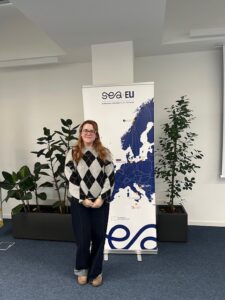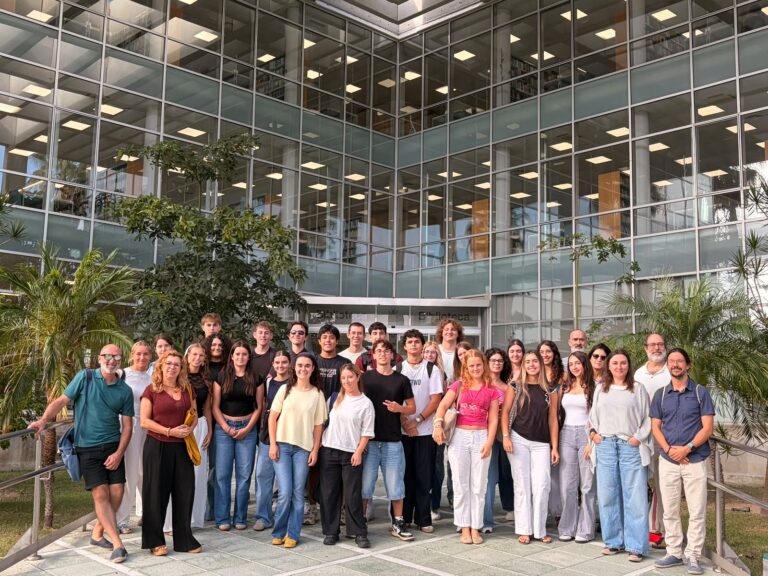
During the recent Staff Week held in Split and organized by the Observatory of Migration and Human Rights (OMHR), Marian Bellido, Pre-doctoral Researcher at the University of Cádiz (UCA), delivered a presentation entitled “From ‘Adversaries’ to ‘Allies’: A Model for State–NGO Coordination to Reinforce Maritime Rescue Capacity in the Mediterranean.”
The presentation forms part of the R&D project FEDER-UCA-2024-A1-37, “The mass arrival of immigrants at Europe’s southern external borders: a comparative study of Spain, Italy, and Malta from the perspective of international and EU law,” led by Dr. Ángeles Jiménez García-Carriazo (UCA).
In her intervention, Bellido analysed the growing fragmentation of search and rescue operations in the Mediterranean. She highlighted that the lack of effective coordination between states and private actors has significant legal and humanitarian consequences.
According to her research, the Mediterranean has increasingly become a space of legal tension and political disagreement, where rescue obligations are often hindered by bureaucratic, legal, and political obstacles.
Bellido presented a comparative analysis of Spain, Italy, and Malta, examining how these countries approach maritime rescue in situations of mass arrivals. She outlined the main legal and policy measures adopted by each state and assessed their impact on cooperation with non-governmental organisations.
At the core of her presentation was a forward-looking proposal: transforming NGOs from actors often perceived as adversaries into recognised and institutional partners in maritime rescue operations.
Her proposed model includes:
- The development of shared communication protocols between states and NGOs, drawing inspiration from initiatives such as WatchTheMed Alarm Phone.
- The creation of mechanisms to reduce the operational and financial burden of rescue operations on commercial vessels.
- The promotion of a multilateral governance framework aligned with the objectives of the United Nations 2030 Agenda for Sustainable Development.
Bellido concluded that strengthening maritime rescue capacity in the Mediterranean requires not only operational improvements but also a normative shift. Moving beyond a purely securitised approach towards structured cooperation would reinforce compliance with international law, improve the protection of human rights, and strengthen the European Union’s commitment to humane and responsible migration governance.
Her presentation generated significant interest among participants and positioned the “adversaries to allies” model as a timely contribution to current debates on migration, sovereignty, and humanitarian responsibility at Europe’s southern maritime borders.