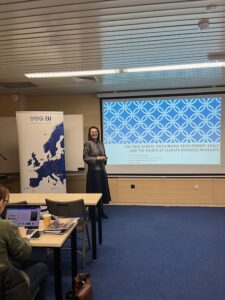
From 21 to 23 January 2026, the Staff Week of the Observatory of Migration and Human Rights
was held in Split. Among the featured speakers, Professor Marita Brčić delivered a
presentation on the connection between migration and the 2030 Agenda for Sustainable
Development, placing particular emphasis on the guiding principle of “leaving no one behind.”
Professor Brčić explained that the 2030 Agenda is the first comprehensive United Nations
framework to explicitly recognise migration as a core element of development policy. In
particular, SDG Target 10.7 calls for orderly, safe, regular and responsible migration and
mobility, directly linking migration governance to the objective of reducing inequalities within
and among countries. She stressed that migration should not be viewed solely as a
humanitarian concern, but as a structural dimension of sustainable development that requires
coherent, long-term strategies.
She presented updated global figures showing that the number of international migrants rose
from about 154 million in 1990 to around 304 million in 2024, representing approximately
3.7% of the world’s population. According to the United Nations High Commissioner for
Refugees, by the end of 2024, 123.2 million people were forcibly displaced worldwide. This
figure includes 42.7 million refugees, 73.5 million internally displaced persons, 8.4 million
asylum-seekers and 4.4 million stateless individuals. In other words, roughly one in every 67
people on Earth has been forced to flee. These figures, she noted, reflect an unprecedented
global displacement crisis that demands coordinated international responses.
A further part of her intervention focused on the increasing interaction between conflict and
environmental crises. In 2024, extreme weather events reached record levels, and over 70% of
forcibly displaced people were living in countries highly exposed to climate-related hazards,
particularly in sub-Saharan Africa and the Asia-Pacific region. Professor Brčić stressed that
displacement today is rarely caused by a single factor; rather, climate change, poverty and
political instability often converge, deepening inequality and vulnerability. Projections indicate
that by 2050 between 200 million and 1 billion people could be compelled to relocate primarily
due to climate-related impacts.
She also addressed the significant legal gap concerning climate-related displacement. The 1951
Refugee Convention does not recognise “climate refugees,” leaving those forced to flee
environmental degradation without a clear international protection framework. This situation
raises urgent questions about the need to adapt or expand existing legal instruments in order
to respond to emerging realities.
In conclusion, Professor Brčić affirmed that while migration is now firmly embedded within the
Sustainable Development Goals, substantial governance and legal challenges remain. Fulfilling
the 2030 Agenda requires coordinated international action that fully integrates migration and
climate realities, ensuring that truly no one is left behind.