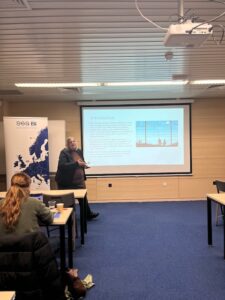
During the Staff Week in Split, held from 21 to 23 January and organized by the Observatory of Migration and Human Rights, Tanja Ellingsen delivered a comprehensive lecture titled ‘TOWARDS A SHIFT IN EUROPEAN MIGRATION POLITICS: FROM MULTICULTURALISM TO REMIGRATION?’. Her presentation provided an in-depth historical and normative analysis of European migration policies, examining their evolution from the era of multicultural optimism to today’s security-focused paradigm, and exploring the implications for democratic legitimacy, human rights, and the Sustainable Development Goals (SDGs).
Ellingsen began by revisiting what is often described as the “era of multiculturalism” (1970s–2000s). During these decades, multiculturalism emerged as a distinct political ideology and social movement across Western Europe. Against the backdrop of globalization and narratives such as the “global village” and even the “end of history,” migration was largely framed as a structural and, in many respects, positive phenomenon. Public policies in numerous countries embraced forms of ethnic and cultural pluralism, recognizing the coexistence of diverse traditions within shared political communities. Multiculturalism was widely perceived as a progressive response to increasing diversity, premised on dialogue, equal rights, and the preservation of distinct identities within democratic frameworks.
However, Ellingsen argued that this consensus gradually eroded. She introduced the concept of “sustainable migration,” drawing on the work of Paul Collier and Alexander Betts. In their view, migration must enjoy democratic support in receiving societies, serve the long-term interests of both origin and destination countries, benefit migrants themselves, and remain ethically legitimate, economically viable, and socially sustainable. Policies that fail to balance these dimensions risk losing public trust and becoming politically unsustainable. Collier, in particular, has criticized Europe’s migration governance as incoherent and reactive, pointing to short-term crisis management during 2015–2016, abrupt border openings followed by closures, and the lack of a clear distinction between refugee protection and economic migration.
According to Ellingsen, the 2020s mark a further shift, from sustainability to securitization. Migration is increasingly framed not primarily as a socio-economic issue but as a matter of national and regional security. Since the 2015–2016 refugee crisis, EU institutions and national governments have more frequently portrayed migration as a potential threat to order, stability, and border integrity. This securitization process transforms migration from a matter of routine political management into one governed by an emergency logic.
She examined how narratives portraying migrants as “threats” have been shaped by events such as the 9/11 attacks, subsequent jihadist terrorism, and the rise of far-right extremism, from the 2011 attacks in Norway to later transnational incidents. The growth of right-wing populism in Europe and the United States, amplified by social media dynamics and disinformation campaigns, has further entrenched existential framings of migration. Yet Ellingsen emphasized that numerous studies suggest securitization is politically driven rather than grounded in objective threat assessments. Migration often becomes a mobilizing tool, evoking fears about cultural identity, national cohesion, or hybrid threats such as electoral interference.
A key part of her lecture addressed the mainstreaming of far-right ideas, particularly the concept of “remigration.” Once confined to extremist margins, remigration has become increasingly visible in European political discourse, trending online and promoted by segments of the far right. Although widely regarded as incompatible with constitutional protections, EU law, and the European Convention on Human Rights, its resonance has shifted the overall bargaining space. Centrist parties, under electoral pressure, have adopted tougher rhetoric on deportations and border control in order to counter far-right momentum.
Ellingsen illustrated this recalibration through international examples. In France, the 2023 immigration law tightened family reunification rules and access to social benefits, reflecting a move toward greater selectivity and increased removals. Germany combined liberalized citizenship reforms with intensified debates on deportations and border controls amid the rise of the AfD. The United Kingdom pursued externalization strategies, most notably the Rwanda offshoring plan, emblematic of a broader deterrence logic. At the EU level, the Pact on Migration and Asylum introduces new screening procedures, enhanced data-sharing through Eurodac, accelerated asylum and return procedures, solidarity mechanisms, and crisis regulations, measures designed to harmonize control while preparing for so-called “instrumentalized migration.”
In her tentative conclusion, Ellingsen argued that Europe is not fully replacing multiculturalism with remigration. Rather, it is recalibrating its migration regime around order, speed, and return, under the shadow of a radical proposal that most mainstream actors are unlikely to adopt outright but which nonetheless shifts the discourse toward deportation-centered politics. The emerging framework is more security-oriented than humanitarian in character.
Whether this transformation can restore public trust without eroding liberal-democratic commitments, she suggested, will depend on two key tests: first, ensuring that returns are lawful, targeted, and consistent with human rights; and second, sustaining long-term investment in integration, equal treatment, and local capacity for the millions of migrants who are part of European societies.