On Wednesday, 13 May 2026, the Faculty of Law at Lund University hosted a new session of the Human Rights Law Discussion Group, focusing on one of the most pressing issues in contemporary international law: the protection of human life at sea and the legal responsibilities surrounding maritime rescue operations.
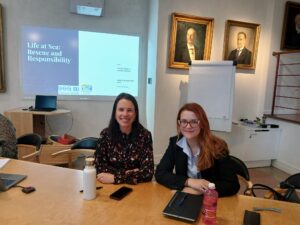
The seminar, titled “Life at Sea: Rescue and Responsibility”, took place at 14:00 h in the Styrelserummet room and online via Zoom. The event featured presentations by Ángeles Jiménez García-Carriazo and María de los Ángeles Bellido Lora, both affiliated with the Jean Monnet Centre of Excellence in Migration and Human Rights at Europe’s External Borders at the University of Cádiz.
Search and Rescue (SAR) operations have represented one of the clearest expressions of the duty to protect human life under international law. Rooted in long-standing maritime tradition, this obligation is enshrined in key international instruments, including the International Convention on Maritime Search and Rescue (SAR), the International Convention for the Safety of Life at Sea (SOLAS), and the United Nations Convention on the Law of the Sea (UNCLOS).
These legal frameworks established that assistance must be rendered to any person in distress at sea, irrespective of nationality, migration status, or other circumstances. However, the practical implementation of these obligations has increasingly become contentious, particularly in the Mediterranean, where migration management policies have often intersected with humanitarian responsibilities.
The seminar examined the legal and operational challenges currently affecting SAR missions in the Mediterranean region. Particular attention was given to recurring disputes concerning disembarkation procedures, the allocation of responsibility among states, and the interpretation of what constitutes a “place of safety” for rescued individuals.
Through selected case studies, the speakers explored how state practices related to migration control and border enforcement can limit, reshape, or delay rescue operations. These tensions raise important questions regarding state accountability, compliance with international law, and the balance between humanitarian obligations and national migration policies.
The discussion ultimately highlighted the widening gap between established legal principles and operational realities at sea, underscoring the need for enhanced international cooperation, legal clarity, and consistency in the application of SAR obligations.
The seminar took place at a time when the Mediterranean continued to be one of the world’s deadliest migration routes. Debates surrounding maritime rescue, border security, and the protection of fundamental rights remained at the centre of European political and legal discussions.
By bringing together scholars and researchers working at the intersection of migration, international law, and human rights, the Human Rights Law Discussion Group continued to provide an important academic platform for examining some of the most urgent humanitarian and legal challenges facing Europe.