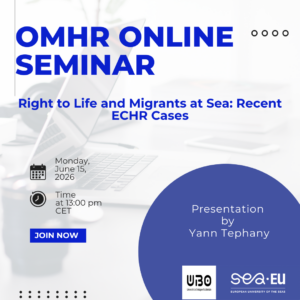
On 15 June, the Observatory of Migration and Human Rights will host a new edition of its online seminar, an academic event focused on the analysis of recent case law of the European Court of Human Rights concerning maritime migration and the protection of the right to life.
In this edition, the seminar will be delivered by the University of Brest, through Professor Yann Tephany, who will present under the title:
“Right to Life and Migrants at Sea: Recent ECHR Cases”
The session will address, in an accessible yet rigorous manner, some of the key legal challenges surrounding the protection of human rights in the context of maritime migration, with particular emphasis on recent jurisprudence of the European Court of Human Rights.
In particular, the presentation will focus on two closely connected thematic axes. First, it will examine the use of force against migrant vessels by state agents, a subject that raises complex questions regarding the limits of state action in maritime border control and the safeguarding of the fundamental rights of persons in transit.
Second, the seminar will explore the States’ obligation to protect the right to life in the context of search and rescue operations in territorial seas. This positive obligation is especially significant in situations of heightened migratory pressure, where operational capacities, administrative decisions, and international legal duties must be carefully balanced to ensure the effective protection of human life.
The discussion will draw on concrete cases originating in the 2010s, which were adjudicated by the European Court of Human Rights (ECtHR) in 2025. These recent judgments shed light on the evolving jurisprudence of the Court regarding state conduct at sea, as well as the consolidation of increasingly precise legal standards on international responsibility.
The seminar aims to remain accessible to a broad audience, combining legal analysis with a broader reflection on the current challenges of migration governance in the European maritime space. In this regard, it seeks to foster an informed discussion on issues situated at the intersection of the law of the sea, international human rights law, and migration policy.
The online format will enable participation from attendees across different countries, including academics, legal practitioners, students, and members of organisations interested in the field. Following the main presentation, a discussion session will be opened to encourage the exchange of ideas and critical engagement with the topics addressed.
With this new session, the Observatory reaffirms its commitment to the dissemination of legal knowledge and to fostering academic debate on contemporary issues of significant social and legal impact.