In October, the Blended Intensive Program (BIP) on the topic “Migration Narratives: Towards Border Literacy in Europe and the Americas” took place in Kiel. The organizer and host, Prof. Dr. Jutta Zimmermann from the English Department at Kiel University, describes the event.
What are the central themes of the BIP?
“Border Studies” examines how borders, migration, and migrants are represented in literature and the media. Studies show, for example, that migrants are often portrayed in the media as either a threat or as victims. While these opposing positions are generally attributed to different political views, they are actually complementary, as they share a view of migration that frames it as a problem or challenge that must be managed. Migrants themselves are rendered invisible in such a perspective. The goal of our course – taught by four instructors from Brest, Gdańsk, Kiel, and Split – is to scrutinize these discourses on migration and develop a critical perspective. We examine literature and films, but we also engage with scholarly literature that addresses migration narratives in an abstract sense. Migration is an important political issue both on the North American continent and here in Europe, and through SEA-EU, we are interested in transnational and transcontinental comparisons.
In the course, participants from the various SEA-EU universities work together in groups. From the very beginning of the seminar, this brings different perspectives and points of view into contact with one another. Before traveling to Kiel, participants explored their own cities under the theme of “Borders” and either conducted an interview or documented “borders” through anecdotes or photographs. They then share these experiences at the start of the event, quickly sparking conversation. The various aspects and dimensions of “Borders” are thus discussed based on their own experiences before being explored more systematically as the course progresses. Together, the participants prepare a presentation inspired by the works discussed as the course progresses. This can take the form of a creative project—such as a podcast or a screenplay—or it can have a theoretical or analytical focus. The result is then presented and evaluated in an online session following the time spent in Kiel.
“The goal of our course is to scrutinize these discourses on migration and develop a critical perspective”
This is the second BIP on this topic. How did it differ from the first one, which you organized last year in Brest?
The topic is actually the same, but we’ve placed an emphasis on local aspects. Last year in Brest, the focus was very much on emigration from Brittany to America. We travelled to Finistère and visited the memorial sites and monuments there. For Kiel, I chose German colonial history as the thematic focus. We took an excursion to Hamburg and explored the extent to which German colonial history—which plays a rather minor role in public discourse—is present in the city and the port. The fact that Hamburg and its port played a significant role in colonial history is evident, for example, in the architecture and buildings such as the Chile Haus, the Afrika Haus, and the Speicherstadt. It’s very impressive just how visible these colonial connections are.
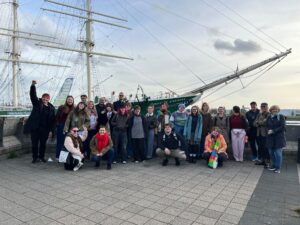
As far as organization goes—we’re always learning. Compared to the first time, we gave the course a clearer structure and communicated the objectives even more clearly from the start. As a result, the students had a better understanding by the end of what was expected of them following the in-person session. I was also pleased that students who participated in Brest last time helped out here in Kiel as teaching assistants this time, allowing them to pass on some of their experience. It was also an enriching experience for them. We’ll definitely take some of what we’ve learned here and apply it to organizing next year’s BIP in Split.
What was the highlight of the course here in Kiel for you?
For me, it was the field trip to Hamburg. When you’re doing such an intensive program, it’s important to get out and about, rather than just sitting in a classroom. In Hamburg, we took what’s called an “alternative harbour tour,” offered by the Hafengruppe Hamburg. A harbour tour is, of course, a staple of any visit to Hamburg, but this one also gave us a different perspective by focusing on the issues of migration and racism. First, we went through the Speicherstadt, where we learned about colonial connections, for example, while further out near the cruise ships, we heard about the crews and their working conditions and legal status.
“We’re considering developing a joint research project on knowledge systems”
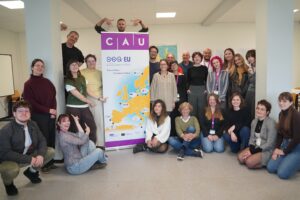
What does SEA-EU mean for your work and teaching?
Without SEA-EU, our collaboration wouldn’t even exist. At first, we—that is, colleagues from Brest, Gdańsk, Split, Cádiz, and Kiel—established a North American network through SEA-EU and held workshops on various topics before identifying migration and border studies as a common field of research. This collaboration has already given rise to a wide variety of activities—in addition to the BIPs, for example, participation in a conference in Gdańsk or joint participation in a SEA-EU Staff Week. No w we’re considering developing a joint research project on knowledge systems. But the greatest benefit, of course, is for our students. It’s wonderful that they can participate in such an international event. The opportunity to combine an academic seminar with a trip to another country or meeting students from other European nations gives students a different perspective on their studies.