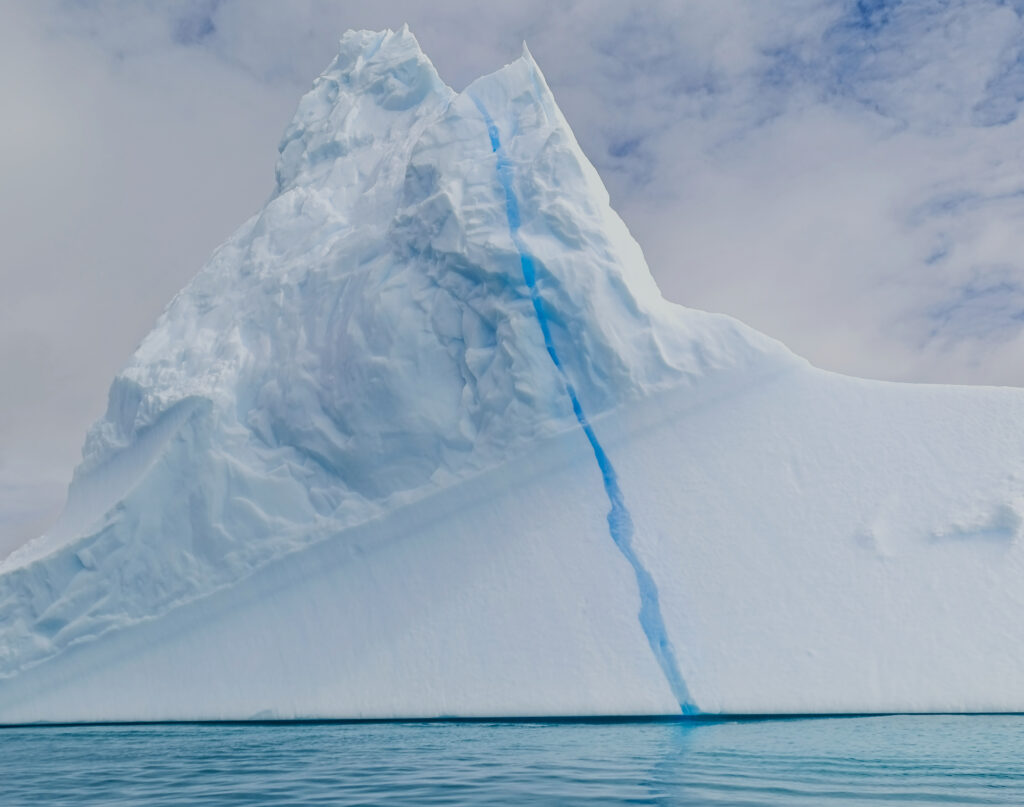
The winning photograph of the SEA-EU Photo Contest 2026: After all – After oil! is much more than a striking Antarctic landscape. Through a fractured iceberg set against the stillness of the polar world, José Teixeira captured both the beauty and fragility of our planet — a moment that deeply resonated with the SEA-EU community.
José, a Marine Biology student, took the photograph during a plankton sampling expedition near King George Island, Antarctica, as part of his Master’s thesis research. What began as a scientific field mission became an unforgettable visual testimony of environmental change.
“The entire scenario itself was inspiring,” José explains. “We were in an area around King George Island that we had not explored before during our sampling campaign, and the landscapes there were absolutely unforgettable.”
While approaching a massive iceberg by zodiac boat, one detail immediately caught his attention — a dramatic fracture running from top to bottom across the ice.
“When I saw the massive crack running through it, I was completely hypnotized. Even though photographs can capture beauty, nothing compares to actually standing there and witnessing the scale and atmosphere in person.”
For José, the contest theme After all – After oil! carries a powerful environmental meaning. He sees it as a reflection of the consequences of decades of fossil fuel dependency and the growing pressure climate change places on ecosystems worldwide.
“Even though society is taking steps toward greener solutions, I think it is easy to underestimate the scale and long-term impact of climate change,” he says. “In polar regions especially, these changes become impossible to ignore.”
The photograph itself was taken during a field expedition focused on plankton sampling. Surrounded by penguins resting atop floating icebergs and the vast silence of Antarctica, José encountered a scene that felt almost unreal.
“We stopped near a huge iceberg with penguins resting on top of it. When we moved to the other side, I noticed this incredible fracture crossing the entire iceberg. It was one of those rare moments where it doesn’t even feel real.”
Beyond its visual beauty, the image carries a deliberate message.
“I wanted the iceberg to symbolize a system reaching its breaking point,” José explains. “At first glance, the image looks calm and peaceful because of the colours and Antarctic atmosphere, but at the same time there is an obvious tension created by the fracture in the ice.”
That contrast — serenity alongside visible collapse — became the emotional core of the photograph and perhaps one of the reasons why it stood out among all submissions.
Winning the competition came as a complete surprise to him.
“I had been waiting for the results for a few days and expected some kind of public announcement beforehand, so when I suddenly saw the winning post online, it took me a moment to actually process it,” he says. “It was an incredibly satisfying feeling to realise that people genuinely connected with the photograph.”
Although passionate about photography, José describes himself not as a professional, but as an enthusiast driven by curiosity and storytelling.
His love for photography is closely connected to his fascination with wildlife and nature documentaries — passions that ultimately led him toward Marine Biology.
“When I first entered Marine Biology, it was because of my dream to become a wildlife videographer and help people connect with ecosystems and species they may never see themselves.”
Today, he enjoys photographing landscapes and animals most of all, valuing photography as a way to preserve stories and emotions beyond a single frame. Yet, he also believes some experiences transcend photography itself.
“Sometimes it is important to simply lower the camera and remember that some moments are not meant only to be photographed, but also to be experienced with our own eyes.”
Through his winning photograph, José Teixeira reminded us that climate change is not an abstract concept confined to reports and statistics. It is visible, tangible, and already reshaping some of the most remote places on Earth.
And sometimes, one image is enough to make us stop and truly look.