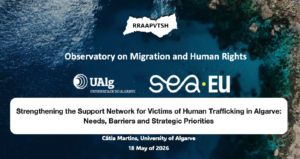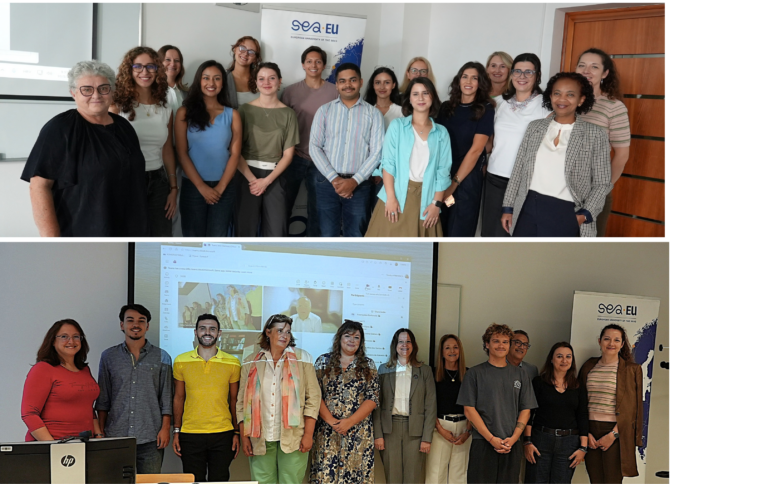
The Observatory recently held its latest academic and professional seminar, a prominent event that brought together specialists, researchers, and practitioners involved in social protection, institutional cooperation, and the fight against human trafficking. The session was delivered by Catia Sofia Martins from the University of Algarve, who presented the key findings of a research project focused on analysing the support network for victims of human trafficking in this southern region of Portugal.
Titled “Mapping the Support Network for Victims of Human Trafficking in the Algarve: Composition and Strategic Priorities”, the seminar attracted considerable interest among attendees, with participation from sector experts who attended as listeners and contributed to the subsequent discussion.
During her presentation, Catia offered a comprehensive analysis of the composition, functioning, and strategic priorities of the regional support network for victims of trafficking in the Algarve. The study, conducted through a methodology based on surveys and institutional analysis, identified both the strengths and the existing challenges within the interinstitutional cooperation system.
Among the main findings presented, particular emphasis was placed on the importance of key areas of intervention, including prevention and awareness-raising, victim protection and support, training and professional capacity-building, as well as coordination and networking among institutions. As explained during the seminar, much of the work carried out in the region focuses on awareness campaigns, psychosocial support, specialised training, and the establishment of cooperation protocols between organisations.
Furthermore, the researcher shared data regarding the institutional profile of the entities participating in the network, noting that many operate primarily at the local level and work with diverse groups, ranging from the general population to children, young people, and migrant communities. The study also revealed that only a small proportion of organisations are specifically dedicated to supporting victims of human trafficking, reinforcing the need to further strengthen specialised intervention mechanisms.
One of the seminar’s most significant aspects was the analysis of the strengths and limitations of interinstitutional collaboration. Among the positive elements identified were the effectiveness of cooperation between organisations, the exchange of best practices, and the strengthening of institutional synergies. Nevertheless, several persistent challenges were also highlighted, including insufficient resources, bureaucratic barriers, coordination difficulties, and the need to improve communication systems and data collection processes.
The seminar concluded with a productive exchange of reflections among participants, who particularly valued the study’s practical dimension and its potential to inform future policies and intervention strategies. Through initiatives such as this, the Observatory continues to establish itself as a meeting point between research and professional practice, fostering dialogue among experts and promoting more coordinated and effective responses to human trafficking.