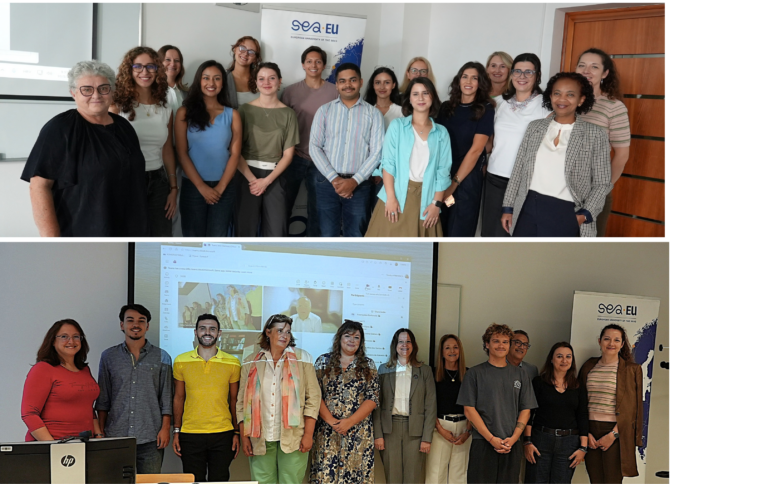
 How can universities help close the gender pay gap? And what are the institutional solutions to support women whose academic careers are interrupted by parental leave?
In this interview, Anna Jurkowska-Zeidler, Vice-Rector for Cooperation and International Relations at the University of Gdańsk, speaks with European Solidarity Corsp volunteer Juan Tejada Sánchez-Romate about fair HR policies, the glass ceiling and the hidden ways in which gender inequalities can also affect areas such as credit score.
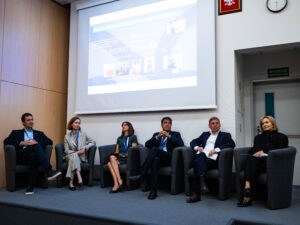
This interview was conducted during the Being SEA-EU Conference, after the Spotlight Vice-rectors panel about Gender Equality in Academia.
JUAN: I found your remarks about the gender pay gap very interesting. Why do you think these inequalities still exist today? Our society seems too advanced for such injustices to continue.
ANNA: We have also collected data on the reasons behind the gender pay gap. One of the main factors is interruptions in academic careers.
For example, we have many female students and PhD candidates who take parental leave for a period of time. When they return to work, their colleagues may already be ahead of them, with higher salaries resulting from career progression during that time. Women on leave miss stages of professional development simply because they are caring for their children.
This can also slow down the path towards becoming a full professor. Balancing family responsibilities, research and teaching obligations is demanding, and an academic career may progress more slowly as a result.
JUAN: What measures should society take to break this glass ceiling and achieve greater equality between genders in the workplace?
ANNA: First of all, institutions need good HR policies. Universities should recognise the impact of parental leave on academic careers and ensure that women returning to work are not financially disadvantaged in comparison with their colleagues.
A fair assessment system should take these circumstances into account and help maintain salary balance. Flexibility and support for employees returning from parental leave are essential if we want to make real progress.
JUAN: During the panel we attended, one of your colleagues mentioned that public institutions may have greater salary inequalities than private institutions. What do you think about that?
ANNA: I do not know the data for Poland, so I cannot comment specifically on this issue. It may be a problem in a particular country or sector. However, generally speaking, the gender pay gap still exists.
This is why we need more research on gender inequalities—not only in HR, but also in economics, management and many other fields. At our university, we strongly support initiatives encouraging researchers to include a gender perspective in their work.
For example, I am a professor of finance law, and gender inequalities may also have indirect consequences in banking. If women earn less on average, this may affect variables used in creditworthiness assessments, even when gender itself is not a decision-making criterion. This raises a broader question: can seemingly gender-neutral algorithms nevertheless reproduce existing gender inequalities?
JUAN: I find that point very clear and interesting. It is an excellent question to begin a deeper reflection on the topic.
Thank you very much for this interview. I appreciate seeing feminism from different perspectives and in different fields.
ANNA: Of course. Thank you very much.
More about European Solidarity Corps project at UG (project code 2024-1-PL01-ESC51-VTJ-000204382): https://welcomecentre.ug.edu.pl/choose/solidarity/
More about Being SEA-EU: https://beingsea-eu.ug.edu.pl/
Photos from the Vice-rectors panel: