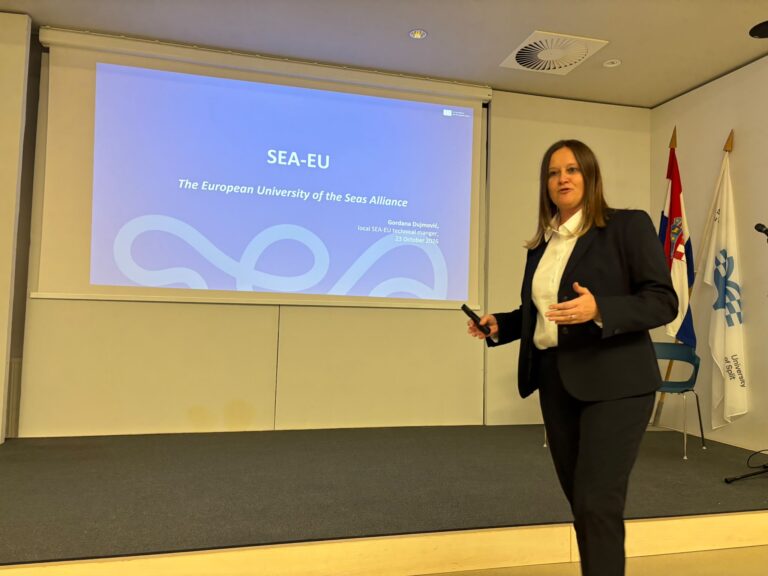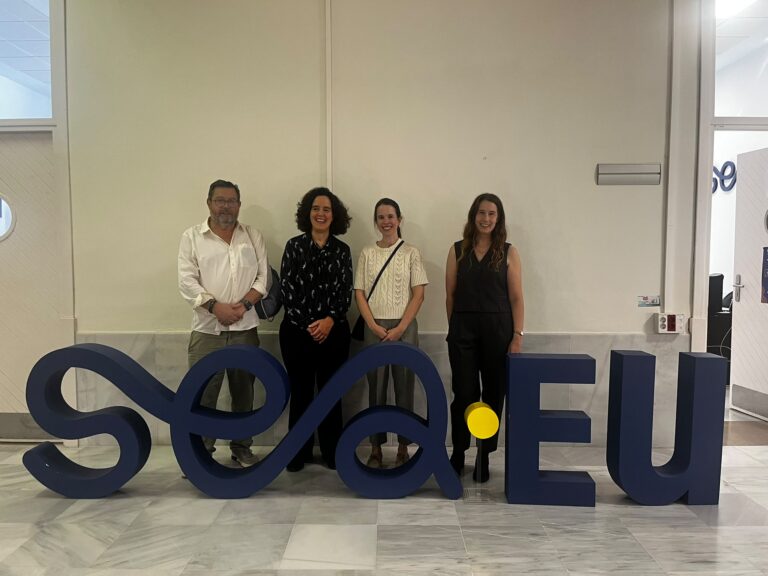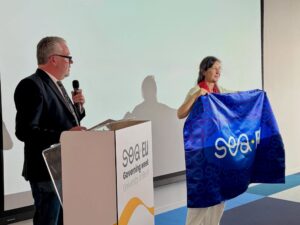
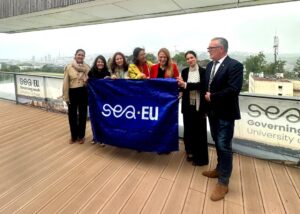
SEA-EU presidency handover from UBO to UAlg in Brest.
A Charter for a Sustainable Future
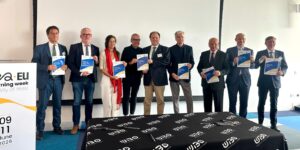
The handover took place following the seventh SEA-EU Governing Week, held from 9 to 11 June at the University of Brest. On the final day, the Alliance reaffirmed its commitment to ecological and societal transition by signing the Charter for a Sustainable Future.
The result of two years of work by the Alliance’s Sustainability Network, the document establishes a shared vision for the nine partner universities and promotes more responsible practices in areas including food, mobility, resource management, biodiversity and student participation. It also provides for common indicators and annual reviews, alongside closer cooperation between institutions to accelerate sustainable campus transformation.
This vision connects with the Inner Development Goals (IDGs), an approach that complements the United Nations Sustainable Development Goals (SDGs) by recognising the individual and collective capabilities needed to address environmental and social challenges.
“The Future Starts on Your Plate”: from vision to action
Among the initiatives illustrating this commitment is “O Futuro Começa no Prato” — “The Future Starts on Your Plate”, a campaign developed by the University of Algarve in June that puts some of the Charter’s objectives and principles into practice locally.
The campaign grew out of the project “Systemic and Sustainable Transformation of the Food System at the University of Algarve”, one of the winning proposals in the 2025 Greening Our Campus ideas competition. Organised within SEA-EU, the competition invited the academic community to propose solutions for a more sustainable university.
Visible change on campus
This commitment is also reflected in changes to the University’s food provision, with a reduction in meat offerings, including the removal of non-local beef, and a wider range of healthy and sustainable options.
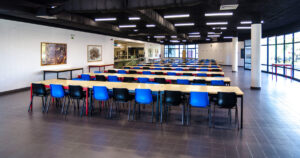
UAlg’s Social Services (SASUAlg) are expanding the options available by introducing meals in campus cafés and opening or reopening food outlets. The gradual modernisation of kitchens, equipment and food preparation processes will also continue, with support from chefs and catering professionals to improve quality, food safety and nutritional balance.
University catering also contributes to the institution’s social mission. The contribution to the Student Social Support Fund (FAS) from the University Restaurant is increasing from €1 to €1.50 per meal, a rise of 50%. Since 2018, more than €85,000 has been channelled into this fund.
Nurturing biodiversity and managing resources responsibly
Campus transformation also involves caring for natural spaces. The “Sowing the Future – Cork Oak Acorn Planting” initiative, held at Gambelas on 26 February 2026, brought together more than 60 students, academics and staff, supported by over 20 volunteers from the UAlg V+ programme.
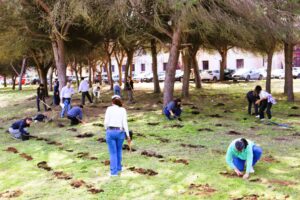
Cork oak acorn planting at Gambelas Campus.
Originating in another winning Greening Our Campus proposal, the activity involved collecting and planting dozens of acorns. The choice of cork oak, a native species, supports biodiversity and forms part of the campus’s climate adaptation efforts, particularly in strengthening resilience to fire risk.
Although it preceded the presidency, the initiative demonstrates the participatory approach that UAlg seeks to advance within SEA-EU: drawing on the community’s knowledge and involvement to put institutional priorities into practice.
Giving a second life to goods and connecting with the community
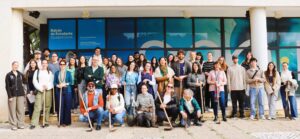
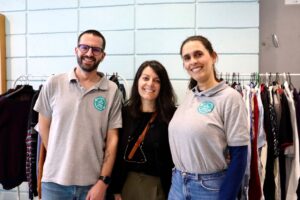
Circular economy initiatives offer further examples of sustainability in practice. The third and fourth editions of the “Segunda Vida” — “Second Life” Fair, held at Gambelas on 3 March and Penha on 28 May 2026, encouraged the reuse of donated clothing, footwear, accessories and books. Organised within SEA-EU in collaboration with the University of Algarve Students’ Association (AAUAlg), the fairs brought students, academics and staff together around sharing, responsible consumption and waste reduction.
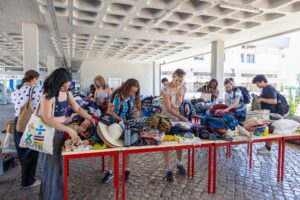
The Second Life Fair promotes reuse and responsible consumption.
Originating in a winning proposal from the 2025 Greening Our Campus competition, the fairs form part of SEA-EU Goes Greener. They demonstrate how ideas from the academic community can develop into recurring activities that put sustainability into practice on campus.
A more inclusive, healthy and innovative university
Sustainability is also reflected in the conditions that enable students to settle into and participate in university life. The opening of two new residences, at Gambelas and Penha, adds 298 beds, bringing total capacity to 837 beds, an increase of approximately 55%.
The new residences represent an investment of around €18 million, of which €8.8 million is funded directly by UAlg. This follows the refurbishment of seven residences, covering 442 beds, completed in 2025 at an additional cost of €8.3 million.
The signing of the agreement to build the Barlavento Campus in Portimão also strengthens the University’s regional presence. Meanwhile, the integration of sport into SASUAlg and the planned expansion of psychology and general practice consultations aim to widen opportunities for participation and improve support for the academic community.
In education, two new Teaching Innovation Laboratories at Penha and Gambelas provide flexible, collaborative and technologically equipped spaces where academics and students can explore new ways of teaching and learning.
Cooperation connecting universities, partners and communities
Engagement with regional stakeholders, including invitations to participate and contribute to events, seeks to connect research and education with regional needs. Cooperation with these organisations complements SEA-EU’s international dimension and brings different perspectives to shared challenges.
From 16 to 25 September, a UAlg scientific and institutional mission to Colombia strengthened cooperation with Universidad del Magdalena and Universidad Simón Bolívar, both external partners of the Alliance.
The Finding Home project was a central focus of the mission, connecting research into fish life cycles with engagement with fishing communities. Fieldwork, scientific meetings and participation in INNOVAZUL Caribe 2026 created opportunities for collaboration in marine science, sustainability and the blue economy.
Alongside this work, the Rector’s engagement with prospective external partners, including invitations to sign the Global Gateway Declaration, seeks to broaden SEA-EU’s international network and create opportunities for new forms of cooperation.
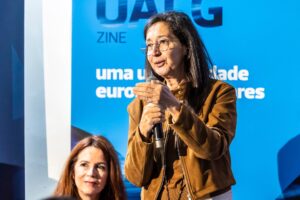
UAlg Rector, Alexandra Teodósio.
Looking towards December and SEA-EU NEXT
From food choices and biodiversity to circular economy initiatives, accommodation, teaching innovation and international cooperation, these initiatives share a common objective: building a more sustainable and inclusive university, prepared for future challenges.