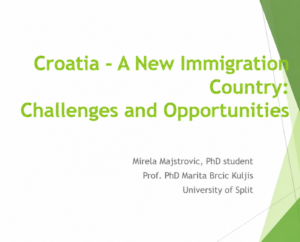
The Observatory of Migration and Human Rights launched a new online seminar series for this
academic year with a session entitled “Croatia – A New Immigration Country: Challenges and
Opportunities”, held on Tuesday, 20 October. The event featured presentations by Marita
Brčić Kuljiš and Mirela Majstrović, who examined the main challenges arising from Croatia’s
changing migration patterns, focusing on labour market integration and educational inclusion.
During her presentation, Marita Brčić Kuljiš discussed the growth of labour migration and the
difficulties Croatia faces in integrating foreign workers. Although their arrival helps meet
labour market needs, migrants are still largely regarded as a temporary workforce rather than
as potential members of Croatian society. She also highlighted the growth of employment
agencies and the problems associated with insufficient regulation, poor coordination between
institutions and limited support services for migrant workers.
Mirela Majstrović focused on the challenges facing the Croatian education system in
integrating migrant children, particularly during the first years of primary education. One of
the main obstacles is learning Croatian. As she explained, the 70 hours of preparatory language
instruction generally provided are insufficient for many children. This is compounded by a
shortage of specialised teachers and limited resources to address their individual needs.
Majstrović also emphasised the socialisation difficulties experienced by children entering an
unfamiliar cultural and linguistic environment, as well as the need to improve teacher training
in multicultural education and intercultural communication. These shortcomings are
particularly significant in some rural areas, where access to support professionals, including
psychologists and specialised educational staff, remains limited.
She further highlighted the importance of reducing teachers’ administrative workload and
strengthening the resources available to support students’ adaptation. Her presentation
underlined that educational inclusion involves more than simply providing access to the
classroom: it also requires language support, psychosocial assistance and measures to
promote interaction and a sense of belonging.
Croatia’s changing migration patterns are closely linked to its demographic situation. In 2024,
the country adopted the Strategy for the Demographic Revitalisation of the Republic of
Croatia, which aims to encourage higher birth rates and facilitate the return of Croatian
citizens living abroad. In 2025, it also adopted the Migration and Asylum Management Plan
until 2030, in line with the European framework.
Furthermore, amendments to the Foreigners Act in 2026 introduced provisions concerning
Croatian language learning and accommodation conditions for foreign workers. These
measures reflect efforts to regulate immigration, although challenges remain in ensuring
adequate living and working conditions.
Through this session, the Observatory launched a new seminar series exploring the challenges
facing contemporary societies from an academic and international perspective. Croatia’s
experience provides an opportunity to reflect on both the opportunities and the difficulties
involved in the transition from a country traditionally associated with emigration to one
increasingly receiving foreign nationals.