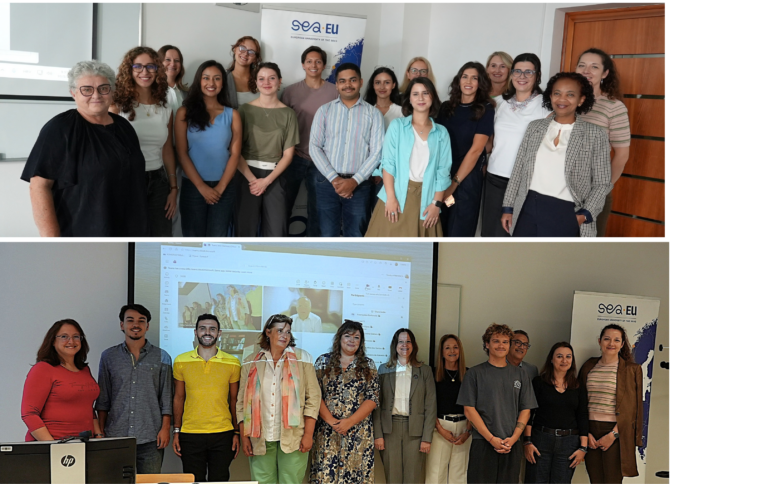
The University of Algarve (UAlg) is launching The Future Begins on the Plate, a new sustainability campaign encouraging the academic community to adopt more conscious, balanced and responsible food choices. Born from one of the winning projects of the 2025 edition of the Greening Our Campus Contest, promoted under Task 4.4 – SEA-EU Goes Greener, the initiative highlights how ideas developed within SEA-EU can evolve into concrete actions with real impact on campus.
Under the tagline “Small choices. Big impact.”, the initiative is rooted in the connection between human health and planetary health. Small choices on the plates of university students — with a greater proportion of vegetables and foods of marine origin — can generate a significant impact on the planet and on health, contributing to a more balanced and equitable diet in the future and to reduced pressure on natural resources, both in water consumption and waste production.
This is one of the most visible ways in which UAlg gets involved in global initiatives such as the recently celebrated World Environment Day (5 June) and World Oceans Day (8 June), demonstrating its active commitment to protecting nature and the planet as a whole.
Small choices. Big impact.
How did this initiative come about?
Through this initiative, UAlg reinforces its commitment to promoting healthier habits, making the most of local resources and building a more sustainable university in the region and across the world. Looking after your health and the planet can start with your next meal.
What is the environmental impact of current food systems?
Current food systems account for around 26% to 34% of global greenhouse gas emissions, with beef production emitting more than 50 kg of CO₂ equivalent per kg of food, making it one of the products with the greatest environmental impact. The current context, characterised by climate change, geopolitical instability and rising global inflation, demands a clear and effective response from higher education institutions.

What are the ‘blue’ options and what are their benefits?
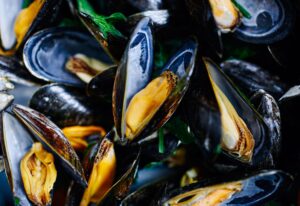
So-called ‘blue foods’, which come from marine environments – such as pelagic fish (notably sardines and mackerel) and bivalves such as mussels and clams – provide essential nutrients such as high-quality protein, vitamin D, vitamin B12 and iron, which are usually associated with the consumption of beef. Furthermore, these ‘Blue Foods’, as well as seaweed – like most local and regional vegetables – may have a lower environmental impact than beef. They are therefore a nutritionally rich and more sustainable alternative for human health.
The evidence gathered through the work of Carlos Duarte (Honorary Doctorate from UAlg) demonstrates that a marine-based diet, particularly through marine aquaculture and seaweed production, can play a decisive role in global food security and the transition to more sustainable food systems.
How does this change help the planet and reduce inequalities?
A diet based more on sustainably produced plant- and sea-based foods contributes not only to health and environmental sustainability, but also to social justice. This shift helps to reduce pressure on land, water and biodiversity, whilst helping to counteract inequalities between the Global South and North in the distribution of the costs and benefits of food systems, such as those based on beef, which draw on vast resources from the South to feed a small proportion of the population in the North. The negative impacts of these systems often fall disproportionately on the most vulnerable populations in the Global South, who face a scarcity of resources – including protein-rich crops – which are diverted to feed livestock that will subsequently feed a select group in the North.
In this context, the transformation of food systems is urgent: profound changes in individual and collective behaviour. It is therefore essential that, in higher education institutions such as UAlg – which have a regional focus but are also strongly internationalised and multicultural – collective initiatives, such as this campaign and the food on offer, are also seen as tools for learning and for promoting more sustainable lifestyles, both now and in the future for our students and our planet, helping to combat climate change and promoting balanced and sustainable dietary patterns that can be adapted to different regions and cultures.
What will change on the UAlg campuses?
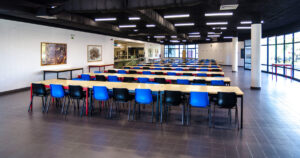
In addition to the reduction in the supply of meat, following the phasing out of certain types – such as beef from non-local sources – in the coming academic year, this change will also be evident on university campuses, with the provision of more diverse, healthy and sustainable food options – ‘green and blue’. In Gambelas, a new space is set to open in the Nave das Artes building; in Penha, the refurbishment of the Civil Engineering bar area will go ahead. The initiative is also in line with the objectives set out in the UAlg Horizon 2030 Strategic Plan, which identifies sustainability, healthy campuses and global social justice as the University’s strategic priorities (v), and will be implemented in collaboration with the Pro-Vice-Chancellor for Sustainability Sciences – Vânia Serrão de Sousa – and the Head of Social Services at UAlg – André Botelheiro.