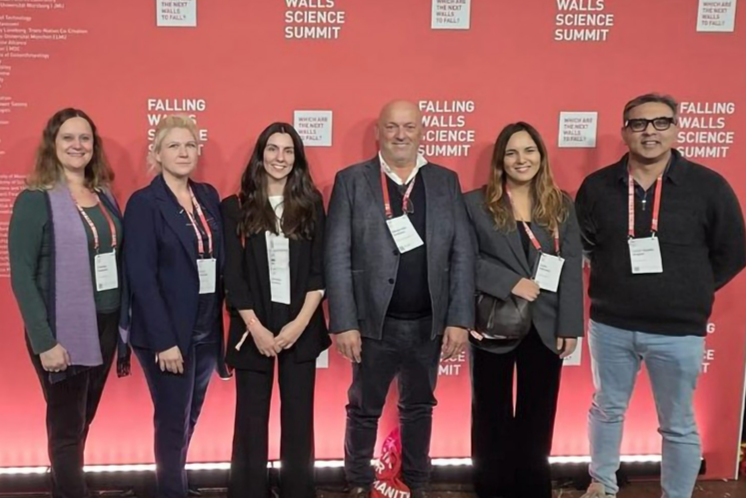
The University of Algarve (UAlg) represented the SEA-EU Alliance at the Falling Walls Science Summit, which took place in Berlin from 6 to 9 November 2026.
The event brings together experts from around the world each year to discuss the future of scientific research in the public and private sectors. Canada was this year’s partner country, and participants explored opportunities for collaboration with Canadian partners.
On the first day of the summit, 100 doctoral students from around the world presented their research. They had been selected through the Falling Walls Lab network.
As part of Task 6.3, the Alliance’s science communication task, SEA-EU organised one of these Labs in line with the Falling Walls Foundation’s guidelines. The task is led by Professor Manuel Célio Conceição, who teaches at the University of Algarve’s Faculty of Humanities and Social Sciences (FCHS) and conducts research at its Research Centre for Arts and Communication (CIAC). By organising the Lab, SEA-EU took part in this year’s summit as a partner university alliance.
In July, University of Algarve PhD student Cândida Cardoso earned the opportunity to represent SEA-EU in Berlin by winning the first SEA-EU Falling Walls Lab, hosted by the University of Split. She was one of 100 finalists at the Falling Walls Lab Global Finale, where she delivered her pitch on 6 November.
Cardoso’s research explores whether molecular ‘fingerprints’ of early changes linked to breast cancer can be detected in the bloodstream, with the aim of helping to identify the disease earlier. The research forms part of her PhD in Biomedical Sciences, supervised by Professor Pedro Castelo Branco.
Manuel Célio Conceição supported Cardoso in preparing her pitch and communicating her research. At CIAC, he also coordinates C3M2, a research group focusing on communication in and about science and cultures, multilingualism and mediation.
Find out more about Cândida Cardoso on the Falling Walls website