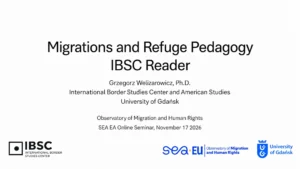
The Observatory has hosted a new online seminar entitled Pedagogical Tools for Teaching about Migrations and Refuge, delivered by Grzegorz Welizarowicz (University of Gdansk), who presented an approach to teaching migration and refuge from a critical, participatory perspective centred on human experiences.
During the session, doctor Welizarowicz shared a range of educational resources and methodologies aimed at fostering a deeper understanding of migration phenomena, moving away from simplified narratives that tend to portray migration solely as a crisis. His presentation emphasised the importance of incorporating migrants’ voices, stories and experiences into learning processes, as well as encouraging critical reflection on the social, political and historical structures that shape these movements.
The main focus of the seminar was the presentation of the International Border Studies Center’s Reader: Migrations and Refuge (University of Gdansk, 2026), a collection of educational materials designed to explore issues related to migration and refuge. This publication brings together interviews, literary texts, comics, plays, workshop activities and academic analyses, offering a wide range of resources for use in educational settings. Through these materials, the aim is to approach migration from different perspectives and foster dialogue, reflection and student engagement.
The speaker also highlighted the importance of a pedagogical approach based on “accompaniment”, active listening and the collective construction of knowledge. From this perspective, the role of educators is not merely to transmit information, but to create spaces where students and teachers can challenge preconceived ideas, share experiences and develop a more critical understanding of reality. Education is thus understood as a tool for social transformation, capable of contributing to justice, empathy and civic engagement.
Another relevant aspect of the session was the need to understand migration as a complex process that cannot be reduced to a single experience or homogeneous narrative. Through testimonies from people who have experienced different migration journeys, the seminar illustrated how these experiences are shaped by factors such as identity, loss, exclusion, memory and support networks. Personal narratives therefore make it possible to connect individual experiences with broader social and structural dynamics.
Furthermore, various pedagogical activities were presented, including storytelling, collective reading, creative writing, poetry and performance-based approaches, which allow migration to be explored in a more engaging and participatory way. These tools encourage students to engage with different realities, develop their analytical skills and recognise the diversity of voices involved in migration processes.
The seminar highlighted the importance of continuing to promote educational initiatives that foster critical thinking and contribute to building more inclusive societies. Through approaches such as those presented by Grzegorz Welizarowicz, teaching about migration and refuge can become an opportunity to challenge prejudice, broaden perspectives and encourage a deeper understanding of the human experiences behind displacement.
Through this new online seminar, the Observatory of Migration and Human Rights continues to promote spaces for exchange, learning and reflection on migration, providing tools and resources to approach this reality from an educational, critical and socially engaged perspective.