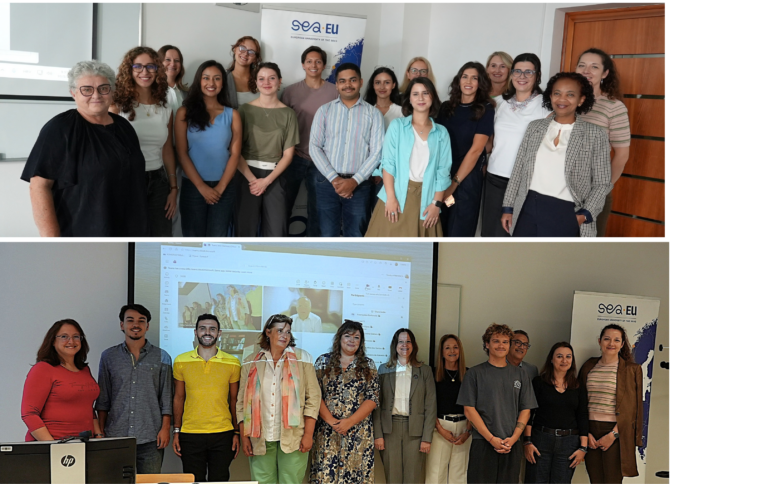
After 15 years of teaching science communication to early career researchers at Kiel University, Ulf Evert and Katharine Simmons are now taking their successful “Science Show” format to universities across Europe. At the beginning of July, the SEA-EU Staff Week “Science Show Train the Trainer”, part of a year-long training program within the framework of Science Comes to Town, took place in Kiel empowering participants to organise their own events.
Outside a summer thunderstorm works itself into a frenzy – inside the seminar room in the Leibniz Strasse the atmosphere is calm. Discarded shoes lie under tables that have been pushed back against the walls; soft, colourful blankets wait on chairs that are arranged in a relaxed circle in the centre of the room. For their regular workshop “Show your Science”, Ulf Evert and Katharine Simmons, come in early to make the room as welcoming as possible. “Our work relies on a great deal of trust,” says Katharine, “creating a space where participants can relax and open-up is important”. But this week, things are slightly different. For the SEA-EU Staff Week “Science Show Train the Trainer”, Katharine and Ulf are taking the participants with them on their process: from preparing the room, to organising rehearsals and giving feedback, all in preparation for their own events.
Step by step
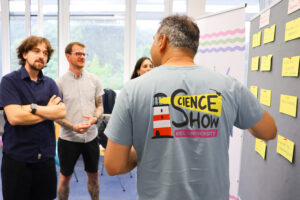
“This week, we’re giving the participants a guided tour of the venues we’ve used in Kiel over the years for our science shows such as Studio Kino or Hansa48,” says Katharine. “We’ve spoken to people who’ve helped us on our journey, and are going deeper into the process of how to create a science show.” It’s not about creating a playbook or template, she says, “it’s more a kind of space to empower people to try their own way of doing things.” Ulf adds that while he and Katharine draw on a wealth of experience, the participants who come to Kiel from across the Alliance, are at the start of their journey. “We look back on 15 years of experience, with all the ups and downs that come with that. Start small and by word of mouth the events will become more and more popular.” “Each location has its own challenges, and players and funding situations,” adds Katharine. “That all needs to be taken into account too. There is no one-size fits all.”
Sean Heath, a senior research advisor at NORD University in Norway, began his science communication journey during his PhD. “It’s fun and has become a bit of a side-hustle,” he explains. “Now I want to take those skills – podcasting, blog editing, running workshops – to the next level and see what that looks like in a more performative setting, on stage.” Reflecting on the week in Kiel, Sean says is impressed by how the number of science communication events in the city seem to co-exist without noticeable competition for attention or funds.
In this context, Katharine points out the years of work in approaching potential collaborators and finding new sparring partners who understood their vision. Along the way, people involved with the Science Shows have also established their own outreach activities in the city such as Pint of Science events, adds Ulf, referring to the annual outreach event where researchers present their work to the public in local pubs and cafés. “These activities have all created a dynamic science communication community in Kiel”, he says.
A playground of ideas
Umair Najeeb Mughal, also from NORD University, whose role at the university focusses on stakeholder engagement, was taken with the idea of using a cinema as a venue for a public science outreach event. So much so, when the group met the owners of Studio Kino as part of their tour of the city, he didn’t hesitate to invite them to Norway to talk about their experience with community partners in Bodo. “Cinemas are really struggling economically,” he says, “and hosting events such as science shows is something I’d never have thought of. It’s clever.”
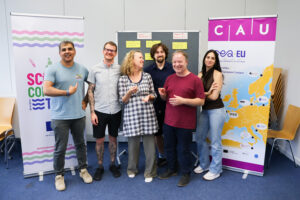
“That’s what makes events like this staff week so great,” adds Ulf. “They are a playground for new ideas that spontaneously emerge and pop-up. Expanding the idea of using cinemas as venues into a European network -that’s something I’d never have thought of myself. “
Marcel Jakubowski from the University of Gdańsk has a background in communication and always knew he wanted to get involved in science communication. “This is an opportunity to develop my skills,” he says. “We’ve never had something like the Science Show at the University of Gdańsk and I’m very happy and proud to introduce this type of event to my university- including my own twist!”
Joana Isabel Pinheiro Rodrigues from the University of Algarve has many years of experience in communication and journalism. “The University of Algarve is leading the SEA-EU work package on science communication and we are using this impulse to highlight the importance of science communication across the university,” she explains. “People and students are curious, and we are on the right track.” Getting involved in “Train the Trainer” program has been part of that development. She’s apprehensive but excited about planning her first science show as part of the next SEA-EU Governing Week that will take place in Faro in December. “We can do this!” she says.
An idea worth spreading
After years of teaching researchers in Kiel, Ulf and Katharine are enjoying the change of focus as they help others establish their own activities. “Yeah, we can sit back and tell all our war stories!” says Katharine. What motivated Ulf and Katharine to take share their expertise with others? “We see how valuable these workshops are for young researchers,” says Katharine. “SEA-EU gives us the opportunity to share our expertise and build networks of like-minded people across Europe” adds Ulf. “Some ideas are worth spreading, and we believe this is one of them. It engages people in other places of the Alliance and helps strengthen trust in science across Europe.”
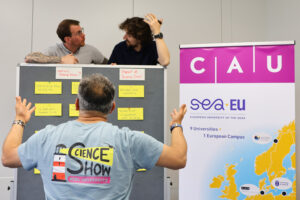
But even Katharine and Ulf are getting something new from the experience. “My highlight is how diverse this group is,” says Katharine. “Everyone brings a different set of talents to the group – writing, film, podcasts, an eye for policy making and business models. The possibility of pooling our resources, skills and strengths is really exciting. This exchange at eye-level has been really encouraging for me too.” The group agrees: “One of the big wins of this course and meeting through SEA-EU has been to develop a community across Europe who are engaged in science communication,” says Sean. “We’ll be able to draw on that expertise as we move forward with our plans for the Science Shows during the next few months, but also far beyond that,” adds Marcel.
—-
So what is a “Science Show”?
It’s taken 15 years, but with the support of the SEA-EU participants, Katharine and Ulf now have a working definition of a Science Show. “It’s a unique format consisting of three or four short live talks in an hour program. Each show is hosted, giving it a frame. The talks are rehearsed and it’s non-competitive – everyone can shine. It’s for early-career researchers who talk about their research to the widest possible audience,” explains Katharine.