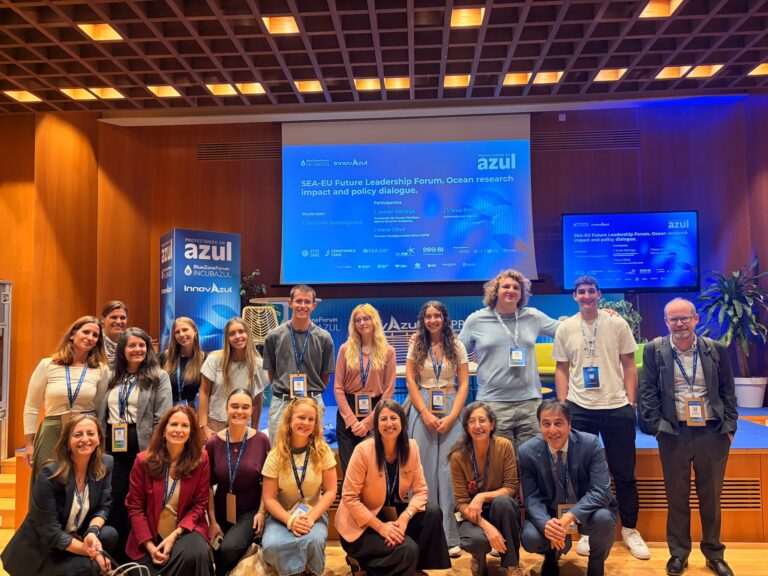
The fourth edition of the SEA-EU Future Leadership Forum, held in Cádiz, explored how scientific knowledge can shape environmental policies, support maritime industries and generate meaningful impact for coastal communities.
The SEA-EU European University Alliance held the fourth edition of its Future Leadership Forum during InnovAzul 2026 in Cádiz, bringing together representatives from academia, research and the maritime sector to discuss one of the most pressing challenges facing ocean science: how to translate research and scientific knowledge into effective policies and practical solutions.
Under the title “Ocean Research Impact and Policy Dialogue”, the session provided a space to reflect on the relationship between scientific research, environmental governance, industry and society, highlighting the importance of collaboration across sectors to address the complex challenges facing marine ecosystems and coastal territories.
Four editions fostering dialogue and cooperation
The Forum opened with an introduction by Patricia Pinto, who reflected on the origins and development of the initiative throughout its three previous editions.
Now in its fourth edition, the SEA-EU Future Leadership Forum offered an opportunity not only to revisit the discussions and experiences of earlier meetings, but also to consider the future direction of the initiative and explore new opportunities for cooperation.
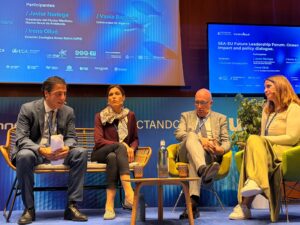
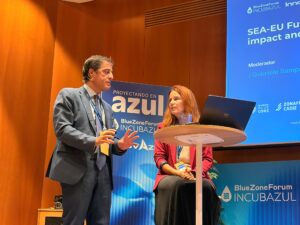
Moderated by Gabriele Sampagnaro, the session brought together three complementary perspectives:
- Irene Olivé, Stazione Zoologica Anton Dohrn, Naples, Italy.
- Javier Noriega, Andalusian Maritime-Marine Cluster, Spain.
- Vania Baptista, University of Algarve, Portugal.
Together, they contributed to a discussion on how to strengthen the connections between ocean research, decision-making processes and the needs of maritime industries and coastal communities.
Breaking down barriers between science and policymaking
One of the central themes of the Forum was the need to bridge the gap between scientific knowledge and its application in environmental policies. Irene Olivé highlighted the importance of combining bottom-up initiatives, emerging from local communities and territories, with top-down approaches driven by institutional policies and regulatory frameworks. Referring to the European Union’s Nature Restoration Law, she emphasised that ambitious environmental regulations require more than political commitments: their effective implementation depends on scientific evidence, cooperation and the involvement of different stakeholders. In particular, she stressed the need to create shared spaces where researchers, policymakers and financial actors can work together, overcoming the institutional and disciplinary barriers that can hinder progress. Her intervention reinforced a key message of the Forum: scientific knowledge must be integrated into decision-making processes if environmental policies are to deliver meaningful results.
Connecting ocean science with the maritime industry
The discussion also addressed the relationship between scientific research and the practical needs of maritime businesses. Javier Noriega, representing the Andalusian Maritime-Marine Cluster, highlighted examples of collaboration between companies and the University of Cádiz, illustrating how academic expertise contributes directly to industrial activities. He referred to the importance of scientific knowledge in areas such as port infrastructure planning, coastal and marine dynamics, bathymetric studies and environmental engineering. These examples demonstrated how businesses increasingly rely on specialised research and technical expertise to address operational challenges and develop projects in complex marine environments. The discussion underlined the value of strengthening connections between universities and industry, ensuring that scientific advances can support innovation, sustainable development and informed decision-making.
The role of university alliances in generating real-world impact
Beyond the individual contributions, the Forum highlighted the importance of creating opportunities for dialogue between communities that do not always interact closely enough.
Researchers generate knowledge that can inform environmental management. Policymakers establish the frameworks needed to protect marine ecosystems. Businesses apply scientific and technological solutions to practical challenges. Coastal communities contribute essential knowledge of their territories and their evolving needs. This is precisely where European University Alliances such as SEA-EU can play an important role. By connecting institutions across countries and disciplines, SEA-EU provides opportunities to share expertise, foster interdisciplinary cooperation and strengthen relationships between universities and their surrounding territories.
The Future Leadership Forum reflects this ambition, offering a platform for discussion that extends beyond academic boundaries and encourages collaboration between research, policy, industry and society.
Looking ahead: strengthening the impact of ocean research
The fourth edition of the SEA-EU Future Leadership Forum reaffirmed the relevance of maintaining spaces for international and cross-sector dialogue on the future of our oceans. Held within the framework of InnovAzul 2026, the meeting demonstrated how European university cooperation can contribute to broader conversations on environmental sustainability, maritime innovation and the role of scientific knowledge in shaping public decisions. As the initiative looks towards future editions, the challenge is to continue strengthening these connections and exploring how dialogue can support more effective cooperation and tangible outcomes.