The European University of the Seas brought together university leaders, researchers, students, businesses and international partners in Cádiz to advance transatlantic cooperation, develop blue economy skills and connect ocean research with real-world challenges.
Hosted in the home city of the University of Cádiz, SEA-EU’s coordinating institution, the event provided an opportunity to showcase how European university cooperation can contribute to addressing shared maritime challenges, strengthening international partnerships and translating knowledge into tangible benefits for society. Throughout the day, SEA-EU brought together university leaders and representatives from Europe and Latin America, alongside researchers, students, businesses and innovation stakeholders, around a common ambition: turning cooperation into meaningful opportunities for the future of our seas and coastal territories.
Strengthening SEA-EU’s institutional cooperation
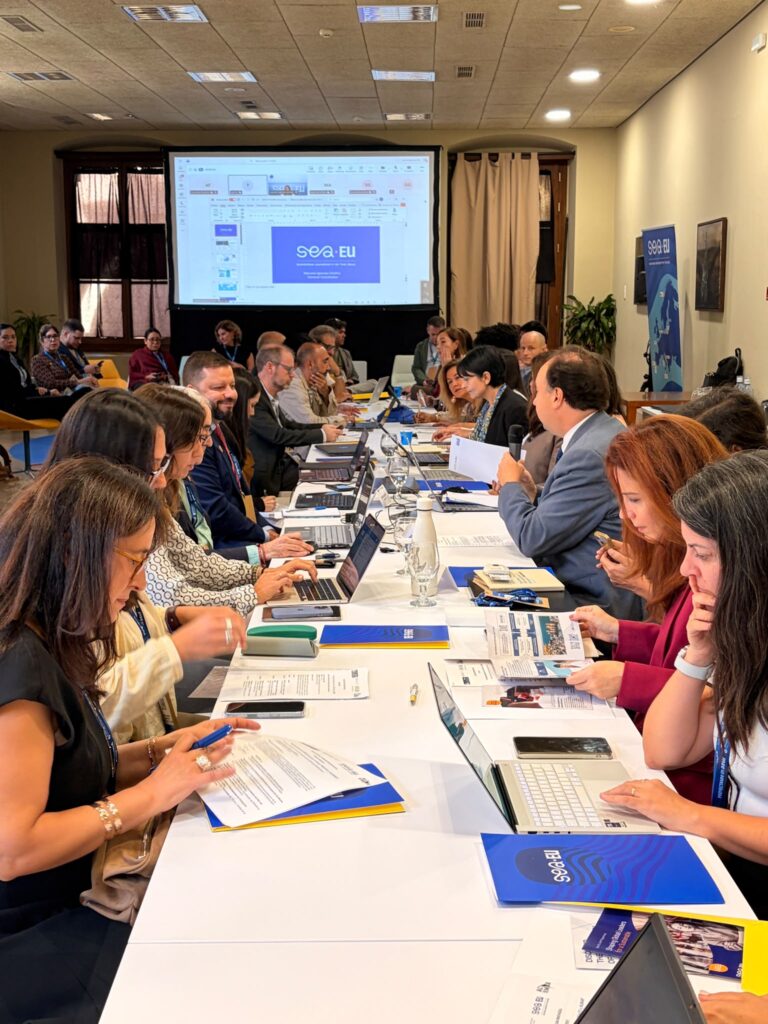
InnovAzul provided the setting for a meeting of SEA-EU university rectors, offering an opportunity to reinforce institutional dialogue and reflect on the Alliance’s ongoing development. The gathering highlighted the importance of sustained cooperation between SEA-EU’s partner universities and their shared commitment to advancing European higher education through internationalisation, joint educational initiatives, research collaboration and engagement with society. Beyond institutional coordination, the meeting also reinforced the value of university alliances as long-term structures capable of creating opportunities that extend beyond individual institutions and national borders.
Connecting Europe and Latin America: SEA-EU meets ALMAR
One of the day’s key institutional highlights was the international meeting “Connecting Alliances through the Sea: SEA-EU and ALMAR”, which brought together representatives of the two university alliances to explore new opportunities for cooperation between Europe and Latin America. The meeting provided a space for institutional dialogue, the exchange of experiences and the identification of potential synergies in education, research, innovation and knowledge transfer. With the ocean as a shared geographical, scientific and cultural connection, the encounter highlighted the potential of university networks to develop partnerships across the Atlantic and address common challenges facing maritime and coastal territories. The discussion also underlined the importance of moving beyond institutional contacts towards identifying concrete opportunities for collaboration, building on the complementary expertise and international networks of the participating universities.
For SEA-EU, the meeting represented an opportunity to extend its international connections and explore new avenues of transatlantic cooperation, reinforcing the Alliance’s commitment to openness, collaboration and global engagement.
Blue skills and education: preparing professionals for a changing economy
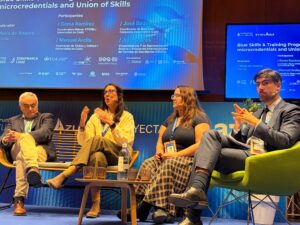
SEA-EU’s first thematic roundtable, “Blue Skills & Training Programs: Joint Programmes, Microcredentials and Union of Skills”, explored how higher education can respond to the rapidly evolving needs of the blue economy. Moderated by María de Andrés García, the discussion brought together Gema Ramírez, coordinator of the STORM joint master’s programme; Manuel Arcila, Vice-Rector for Degrees and Quality at the University of Cádiz; José Vaqueiro, representing BlueCore; and Julia Quirós, from the University of Cádiz Student Council. The session addressed a central question: What skills will future blue economy professionals need, and how should universities adapt their educational programmes to meet these demands?
Participants highlighted the growing importance of interdisciplinary profiles, combining specialised scientific and technical knowledge with digital skills, environmental awareness, adaptability and the ability to work across different sectors. The discussion also emphasised the value of microcredentials and flexible learning opportunities in responding to emerging professional needs. International joint programmes received particular attention as powerful instruments for developing both academic and transversal competencies. Beyond the opportunity to study abroad, these programmes allow students to learn alongside peers from different countries, experience diverse educational environments and develop the intercultural skills required in an increasingly interconnected labour market. The student perspective reinforced the importance of making international opportunities more accessible and ensuring that their benefits are clearly communicated to the university community.
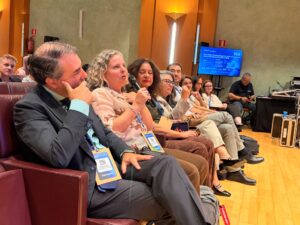
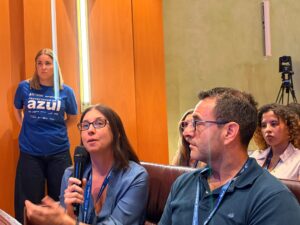
Contributions from the audience, including a representative of Navantia, further highlighted the increasing relevance of soft skills, particularly the ability to interpret information, collaborate, adapt and apply knowledge in real professional environments.
The roundtable illustrated how SEA-EU’s joint educational initiatives and international learning opportunities can help prepare a new generation of professionals for the challenges of the blue economy.
Blue innovation and territories: turning local challenges into international opportunities
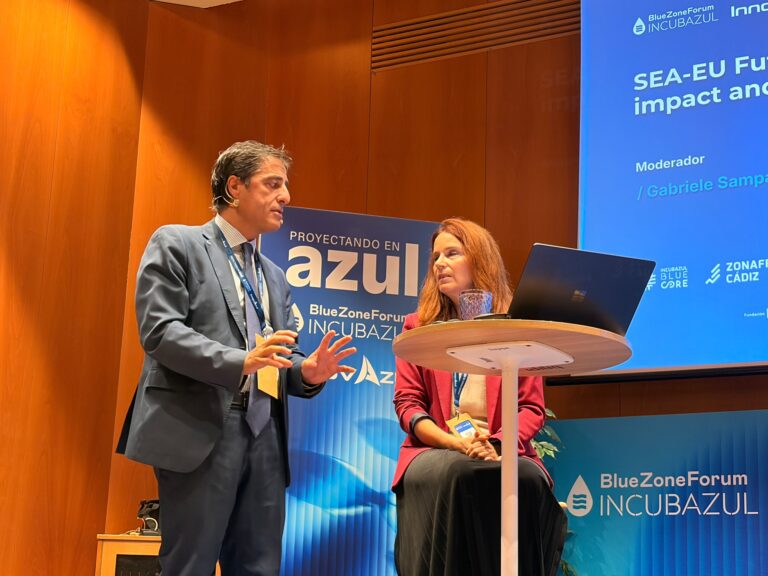
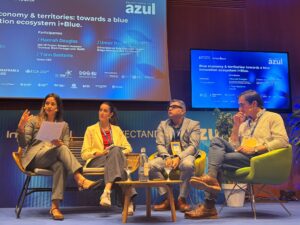
The second roundtable, “Blue Economy & Territories: Towards a Blue Innovation Ecosystem i+Blue”, focused on the relationship between research, entrepreneurship, international networks and the sustainable development of coastal territories.
Moderated by Laura Martín, the session featured Hannah Douglas, from MaREI and the SED’UP project; Yann Santerre, CEO of Gwilen; and Umair Najeeb Mughal, involved in several SEA-EU activities and Nordic Bridge.
A concrete example of circular innovation was presented through SED’UP, a transnational initiative involving partners from Spain, France, Portugal and Ireland. The project addresses a challenge shared by ports across Europe: the large quantities of sediment removed through dredging operations to maintain navigable waterways. Rather than treating this material simply as waste, the initiative explores new pathways for its recovery, reuse and valorisation. This example demonstrated how international research cooperation can help transform an environmental and operational challenge into an opportunity for circular economy innovation.
The discussion also explored the wider strategic challenges facing Europe, including the green transition, innovation capacity, security and autonomy. A particularly relevant contribution for SEA-EU came from Umair Najeeb Mughal, who highlighted the role of European University Alliances and international networks in connecting local problems with knowledge and expertise beyond their immediate territories. His intervention emphasised that communities and businesses often identify challenges that require expertise unavailable within their local environment. University alliances can help bridge this gap by connecting local stakeholders with researchers, students, institutions and international partners capable of contributing to solutions.
This perspective reflects one of SEA-EU’s central ambitions: connecting universities not only with one another, but also with the needs, challenges and opportunities of the territories they serve.
From European cooperation to tangible impact
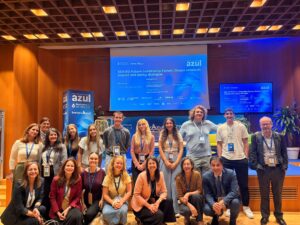
SEA-EU’s participation in InnovAzul 2026 reflected the breadth of the Alliance’s mission and the connections between its different areas of activity.
From developing international joint programmes and preparing students for emerging professional challenges to supporting innovation ecosystems, engaging with maritime industries and facilitating dialogue between science and policy, the discussions demonstrated how higher education cooperation can contribute to the sustainable development of coastal territories.
Across the different sessions, one message emerged consistently: the most complex challenges facing our oceans cannot be addressed by universities, businesses, governments or communities working in isolation.
Through its participation in InnovAzul, SEA-EU reaffirmed its ambition to act as a bridge between institutions, people and territories, creating opportunities for cooperation that extend beyond university campuses. Because the future of our seas depends not only on the knowledge we generate, but on our ability to connect that knowledge with the people and places where it can make a difference.